
Best Account Retention Software for Distributors
The best account retention software for distributors catches accounts before they leave quietly. In wholesale distribution, churn is rarely announced: a steady customer simply drifts past its reorder pattern and buys elsewhere. Retention tools range from CRMs to customer health software, but the ones that work read order history and flag at-risk reorders early.
Why retention is different in distribution
Account retention software was mostly shaped by subscription businesses, where a renewal date is known and a cancellation is a clear event. Wholesale distribution does not work that way. There is no renewal and no cancellation notice. A customer just stops reordering on their usual rhythm and drifts to another supplier, and the loss is only obvious in hindsight.
That makes the retention question a timing question. The best retention tool for a distributor is the one that notices a reorder that should have happened and did not, while there is still time to make a call. Everything else about retention follows from catching that moment early.
Retention tools compared
Each category can support retention in some way. The matrix compares them on catching a wholesale account before it quietly slips away.
| Capability | Allodial Predict | Generic CRM | Customer health software | Spreadsheet tracker |
|---|---|---|---|---|
| Flags a reorder that is overdue | ✓ | – | ◐ | ◐ |
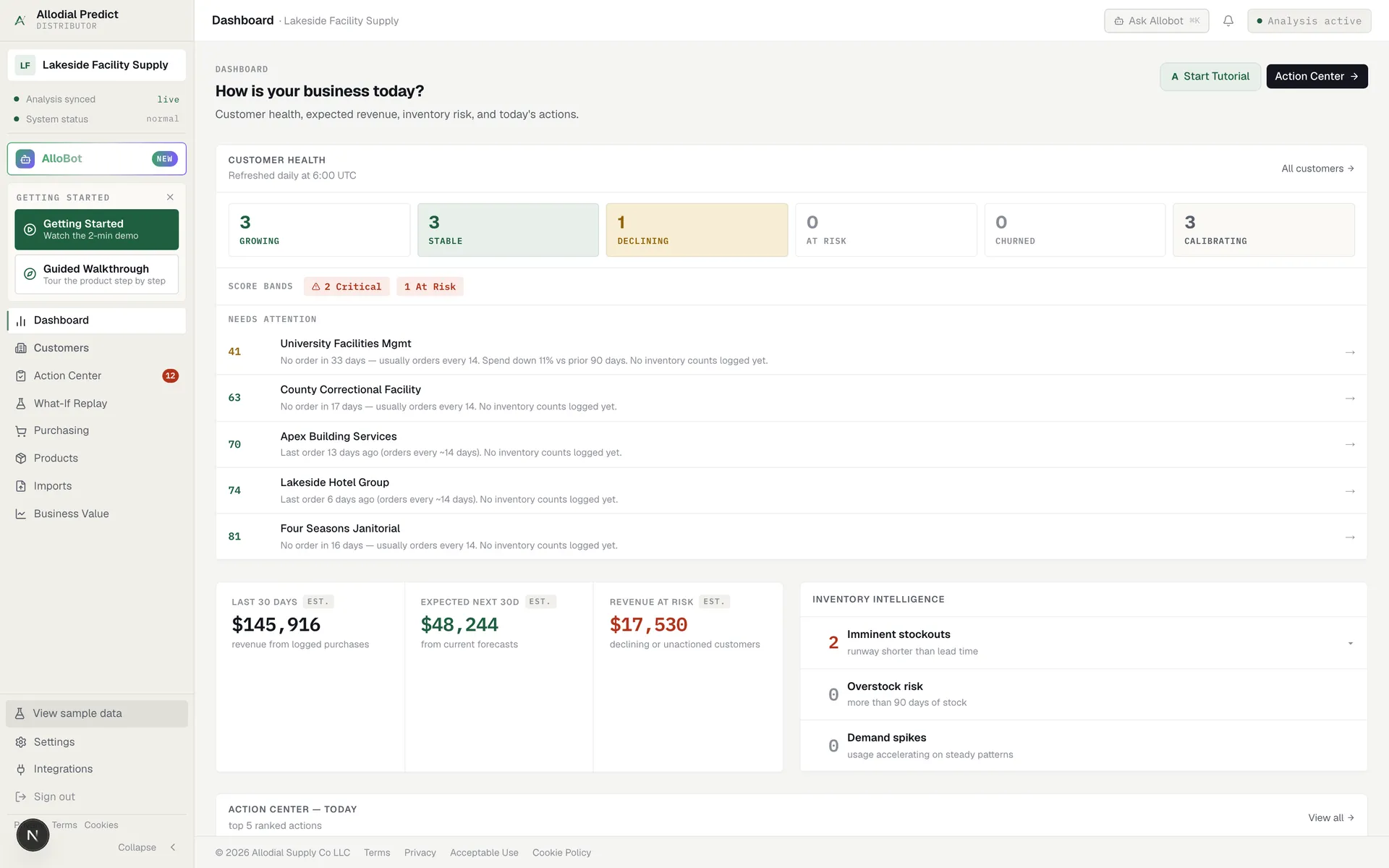
| Detects steady accounts drifting quiet | ✓ | – | ◐ | – |
| Reads order history automatically | ✓ | ◐ | ◐ | – |
| Scores account health for a distributor | ✓ | ◐ | ✓ | – |
| Stores contacts, notes, and follow-up tasks | ◐ | ✓ | ✓ | ◐ |
| Built for recurring reorder revenue, not subscriptions | ✓ | ◐ | – | ◐ |
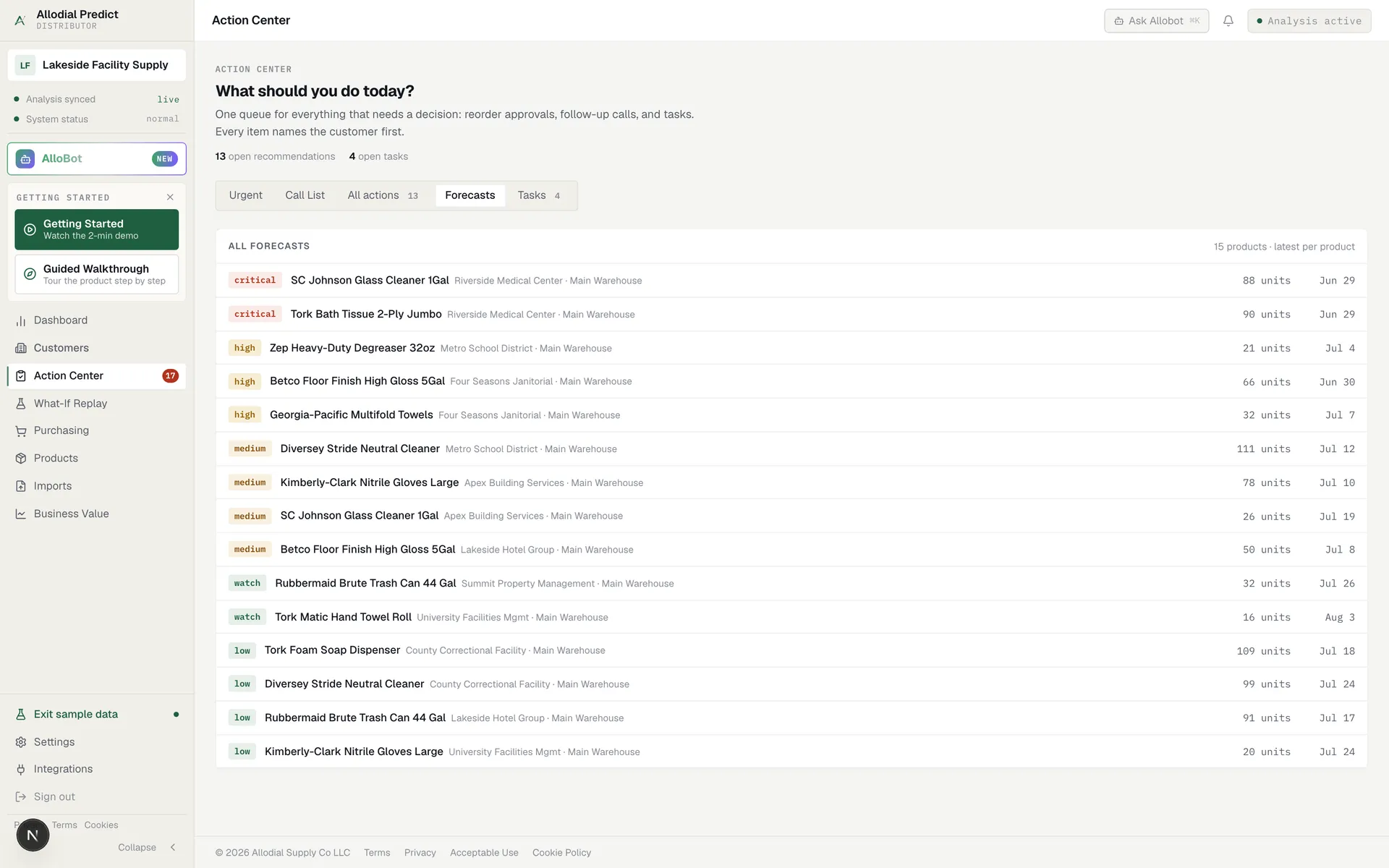
| Ranked daily list of accounts to save | ✓ | – | ◐ | – |
| Setup measured in days | ✓ | ◐ | – | ✓ |
What each category brings to retention
A general CRM helps retention by keeping the relationship organized: contacts, notes, and a task to check in. It rarely knows on its own that a check-in is overdue.
Customer health software is built to score accounts and warn you when one is at risk. Most of it was designed for subscription businesses, where the renewal date is the anchor, rather than for reorder revenue, where the signal is a missed reorder.
A spreadsheet tracker can hold last-order dates and a rough health color, and a disciplined team can run retention from it, until the account count outgrows the formulas.
A reorder-timing tool treats the reorder window itself as the health signal, which fits how distribution actually loses customers.
Retention starts at the reorder window
The reason silent churn is hard is that nothing dramatic happens. A customer does not complain or cancel; they just stop reordering on their usual rhythm, and by the quarterly review the revenue is already gone.
Retention software that waits for a support ticket or a renewal date misses this entirely. The earliest reliable warning in distribution is a reorder that should have happened and did not. Software that watches the reorder window catches the drift while there is still time to save the account.
The difference is measured in weeks, and weeks are everything here. Catch a customer the week after a missed reorder and a single call often brings them back. Catch them a quarter later and they have already built a habit around another supplier, at which point retention turns into win-back, which is far harder and far more expensive.
What to look for in a distribution retention tool
For a distributor, the retention tools worth considering share a few traits.
- They read order history and flag overdue reorders automatically
- They surface steady accounts that are quietly slowing down
- They rank the accounts most worth saving this week
- They fit recurring reorder revenue, not just subscription renewals
Which tool fits your retention problem
If your retention work is mostly relationship management, a CRM may be enough. If you run a subscription-style book, customer health software is a natural fit. If you are just starting to track anything, a spreadsheet beats nothing. But if you lose customers the way most distributors do, quietly, through a missed reorder, a tool that watches the reorder window is the most direct answer, and it can feed the CRM you already use.
The test is simple: ask how you last found out an account was gone. If the answer is a quarterly report or a rep noticing by accident, the tools you have are catching the loss too late, and the reorder window is where the warning you are missing actually lives.
What reps actually work from.
Common questions
Is customer health software the same as reorder-timing software?
They overlap but differ in the signal they watch. Most customer health software was built for subscriptions and keys off renewal dates and usage. A reorder-timing tool keys off the reorder window in order history, which is the signal that matters when a distributor loses an account through a missed reorder rather than a cancellation.
See which accounts are due before the phone rings.
Allodial Predict reads your order history and surfaces the accounts that need a call today.